


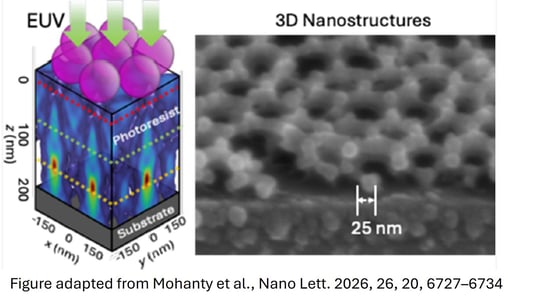
EUV coherent Talbot lithography (CTL) uses the self-imaging of diffracted light to create periodic structures with features smaller than those of the initial pattern. Beyond conventional transmission gratings, colloidal nanospheres can serve as a simple, low-cost periodic structure directly on the photoresist. When illuminated with EUV light, the nanospheres generate a three-dimensional interference pattern through the Talbot effect, which is recorded in the underlying resist.
In a recent study, Dr. Saurav Mohanty and Prof. Chih-Hao Chang group at The University of Texas at Austin utilized a KMLabs XUUS system to generate EUV light through high-harmonic generation (HHG) driven by an ultrafast femtosecond infrared laser. The EUV beam was spectrally filtered to transmit only 30 nm wavelength radiation and focused onto the sample using toroidal mirrors. The researchers used this EUV source to investigate colloidal Talbot lithography and demonstrate both 2D and 3D nanostructures with feature sizes down to 25 nm.
For the initial 2D patterning experiments, the researchers used a thin 40 nm resist film to record the intensity profile immediately beneath arrays of colloidal nanospheres. Nanospheres with diameters of 100, 150, and 200 nm were investigated, allowing the team to examine how the sphere diameter influences the resulting 2D Talbot patterns. By varying the nanosphere diameter and resist thickness, different unit-cell geometries could be fabricated.
The approach was then extended to 3D patterning, where the nanosphere arrays generated a volumetric interference pattern within the photoresist. Using a single EUV exposure, the researchers demonstrated 3D nanostructures with a 25 nm feature size. The results demonstrate the potential of colloidal EUV CTL as a cost-effective and scalable approach to 3D EUV lithography, with possible applications in novel material testing, nanophotonics, and multifunctional nanostructures.
Read the full article here: https://doi.org/10.1021/acs.nanolett.6c01662